
What to do in La Palma when it rains or the calima comes in
First thing to know: cloud where you are staying does not mean cloud across the island. Often you just need to cross to the other side.
by José Daniel Martín, Banana grower and co-founder of Finca Amor Platánico
Published on · Updated on
Here the weather is local. Very local
This throws almost everyone who arrives. La Palma has a ridge above 2,400 metres and that splits the island into two different climates.
The damp winds hit the north-east and unload there. The west, which is where the Aridane valley and Tazacorte are, stays in the lee, and many days it wakes up clear while the other side sits under a blanket of cloud.
So before you write the day off: look at the other side. Half an hour in the car can be the difference between rain and sun.
It works the other way too. If you are in the west and get an odd day, the north may be coming out into sunshine.
What the calima actually is
The calima is dust suspended in the air, carried over from the Sahara. The sky turns milky, the sun looks orange and the horizon disappears.
It is not dangerous for most people, but it spoils two things in particular: the views and the beach. Viewpoints lose nearly all their interest, and the mix of dust and wind makes the beach unpleasant.
It usually lasts a few days. If it catches you, the answer is to reorganise, not to give up.
For the daily forecast, the official source is AEMET, the Spanish met office.
What still works in bad weather
More than you would think, honestly.
Farms and the countryside
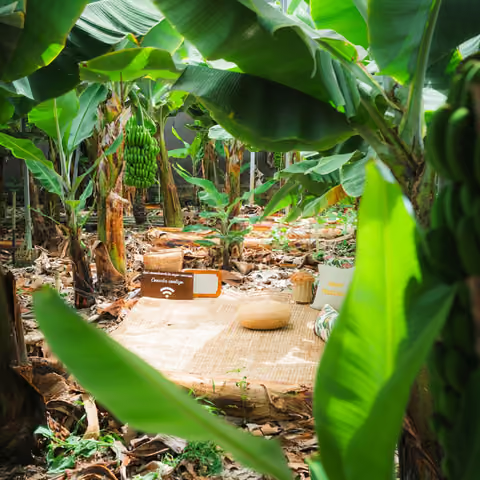
A banana farm visit holds up well in light rain, because almost all of it happens under the leaves. Banana leaves are enormous and shelter far more than you would imagine: you hear the water falling above and barely get wet below.
And with calima it makes no difference: there are no views to spoil here, what you look at is a metre away.
The museums, which are small
On this island museums are not a whole-morning affair, and in bad weather that is an advantage: you can string two or three together. The Banana Museum takes half an hour and costs two euros.
A long lunch
It sounds like an excuse, but it is true: a long lunch at Puerto de Tazacorte, with the sea pounding outside, is one of the best things a bad day can give you. And there is no queue.
What is not worth attempting
The viewpoints. With calima or low cloud you see nothing and the drive is wasted. Save them for the first clear day.
The Caldera de Taburiente in the rain. The Barranco de las Angustias gets slippery and it is not a place to take chances.
The Roque de los Muchachos if there is cloud on the ridge. Sometimes you climb above the sea of cloud and it is spectacular, but if the summit is inside the cloud you will see nothing and it will be cold.
How much daylight you get
This shapes the day more than people reckon. According to the island’s official tourism figures, in winter the sun rises at 7:30 and sets at 18:30; in summer it is light from 7:00 to 20:30.
Two hours’ difference in the afternoon is a lot. In winter, if the morning is poor and it clears at midday, there is no longer time for everything. Prioritise.
The good news: the Canaries get more than 3,000 hours of sun a year and the climate here is spring-like almost all year. Genuinely bad days are few.
If you have something booked
Ask before cancelling. Plenty of outdoor activities here cope with light rain, and whoever runs them knows better than anyone whether it is on.
In our case, the visit goes ahead unless the weather makes it unsafe. If we have to call it off, you choose between another date or a full refund. It is written into our booking terms.
What we do not do is cancel over a few drops. It rains differently here than on the mainland.
The hidden upside of a grey day
Two things improve when the weather gets worse. First: nobody is about. Places that are packed in August are empty under cloud.
Second: the green island actually looks green. With the humidity, the ravines and the laurel forest slopes take on a colour they simply do not have on dry days. Some people come looking for exactly that.
If you are planning the whole trip, it is all in the guide to what to see and do in La Palma.
Daylight and climate figures from visitlapalma.es, checked on 11 October 2026. For the daily forecast the official source is AEMET. The rest is what we see here season after season.