
What to see and do in La Palma
We live and work in the Aridane valley. This is what we answer when somebody asks what to do on the island, with real timings and no embroidery.
by José Daniel Martín, Banana grower and co-founder of Finca Amor Platánico
Published on · Updated on
The first thing to understand
La Palma is 700 square kilometres and you can drive end to end in a little over an hour. On a map it looks as though everything fits into one day. It does not.
The island has a ridge above 2,400 metres, and that changes two things. First, the roads: they are mountain roads, constantly winding, and journeys take far longer than a satnav guesses if it does not know the terrain. Second, the weather: the north-east takes the moisture and the west sits in the lee. It can be raining on one side and clear on the other, the same day, half an hour apart.
Which gives you the best advice we can offer: pick one area and work in a short radius. Crossing the island twice in a day is the most repeated mistake.
The five you should not miss
If you only had time for five things, these would be them. And none of them costs money unless you want a guide.
1. The Caldera de Taburiente National Park
It is the heart of the island and what made it famous long before the volcano: an enormous bowl of vertical walls, with ravines, pines and waterfalls inside. It is a National Park, the highest level of protection that exists in Spain.
You can look in from the viewpoints with no effort, or walk down inside, which is another matter and needs preparation and time. The usual western way in is through the Barranco de las Angustias, itself a Protected Landscape.
2. The Roque de los Muchachos and the sky
The highest point on the island, above 2,400 metres, with the observatory on top. You drive up by road.
But the great thing about La Palma is not seeing it by day, it is by night. The island has its own law protecting the sky from light pollution and was the first to gain Starlight Destination and Reserve certification. On a clear night you see the Milky Way with the naked eye.
And you do not have to go all the way up: there are astronomical viewpoints across the island. We cover it in the guide to things to do as a couple, because it is the night-time plan par excellence.
3. The Tajogaite volcano
The 2021 eruption changed this valley for good. Today you can see it from public, free viewpoints, and get close to the cone with companies authorised by the Cabildo.
What impresses is not the crater: it is the scale of the lava flows running down to the sea, cut sharp exactly where the lava stopped, with untouched green banana terraces beside them. The full guide, with what you can and cannot do, is at visiting the Tajogaite volcano.
4. The forests
This is what most people do not expect from a Canary island. The Bosque de los Tilos and the Las Nieves Natural Park are laurisilva: damp, misty, dark green forest full of ferns. It looks like another planet next to the coast.
It is in the north and north-east, the side that takes the moisture. If you are staying in the west, allow a whole day to go up.
5. The sea
Boats leave Puerto de Tazacorte along the west coast, which has the most marine life. Dolphins are a common sight.
And there is kayaking, paddle surfing and diving. Short kayak routes reach the fajana the volcano created, which are literally the youngest beaches in Spain.
Beaches and rock pools: which to choose
Almost every beach here is black volcanic sand, which throws people expecting white. But black sand heats up less than everyone fears.
The island’s official tourism listing includes, among others: Los Cancajos, Puerto Naos, the beach at Santa Cruz de La Palma, La Zamora, Punta Larga, Porís de Candelaria, La Veta, Charco Verde, Bajamar, Echentive, El Faro and Puerto de Tazacorte.
When the sea is rough — and here it often is — the answer is the natural pools: volcanic rock basins sheltered from the swell. The official ones are Charco Azul in San Andrés y Sauces, La Fajana in Barlovento, Lomada Grande in Garafía and the Poris de Puntagorda.
With children the pools win hands down. It is covered in La Palma with kids.
The volcanic south
Fuencaliente is another face of the island: dry, black, with vines planted in ash. That is where the Teneguía Volcanoes Natural Monument and the Fuencaliente salt pans are, a Site of Scientific Interest where salt is still produced.
It is the area where you most clearly grasp that this is a young island, built from eruptions. And the contrast with the northern forests, on the same island and an hour’s drive away, is hard to believe until you see it.
The towns
Santa Cruz de La Palma, the capital, has one of the best preserved old towns in the Canaries, with its wooden balconied houses. It is where the cruise ships dock.
Los Llanos de Aridane is the town of the valley and has something nowhere else does: more than thirty large-format murals hung on its façades, by artists including Mariscal, Boa Mistura and Okuda. We cover it in what to see in Los Llanos.
Tazacorte, where we are, is two towns: the Villa up the hill and the Puerto below, with the beach. It is in things to do in Tazacorte.
How many days, and how to split them
The thing everyone actually asks.
Three days
One day up high: the Roque de los Muchachos and the Caldera viewpoints. One day in the valley: volcano, Los Llanos, Tazacorte and the beach. And one day in the north: laurel forest and rock pools. It is tight, but it fits.
A week
All of the above unhurried, plus the volcanic south, a walk inside the Caldera, a boat trip and a night of stars. This is the right measure for the island.
Two weeks
Now you can slow down and repeat whatever you liked, which is the real luxury. La Palma rewards slow more than fast.
And if you are arriving by cruise ship with the hours counted, see what you can fit into a call.
When to come
There is no bad season, and that is not brochure talk: the climate is spring-like almost all year and the Canaries get more than 3,000 hours of sun annually.
What does change is the light. In winter it is light from 7:30 to 18:30; in summer, 7:00 to 20:30. Two hours of afternoon is a lot when you are fitting plans together.
The best months, if you can choose: May, June, September and October. August is the busiest.
If you get a bad day, do not write it off: cross to the other side. We explain it in what to do when it rains or the calima comes in.
What nobody tells you before you come
You need a car. There are buses, but the frequencies will not let you chain plans together. Book ahead, especially in high season.
The times mislead. Forty minutes of mountain road is not forty minutes of motorway. And if somebody gets car sick, they will have a hard time here.
People eat late. Three in the afternoon, unhurried. And on Sundays half of everything is shut.
The light burns even when it is not hot. It is the most repeated mistake among winter visitors.
This is not a resort island. There are no big complexes and little nightlife. Anyone coming for that has the wrong island; anyone coming for nature and quiet has the right one.
And one thing that never makes the lists
Every guide to La Palma repeats the same things: volcano, Caldera, Roque, stars. Fair enough, because they are true.
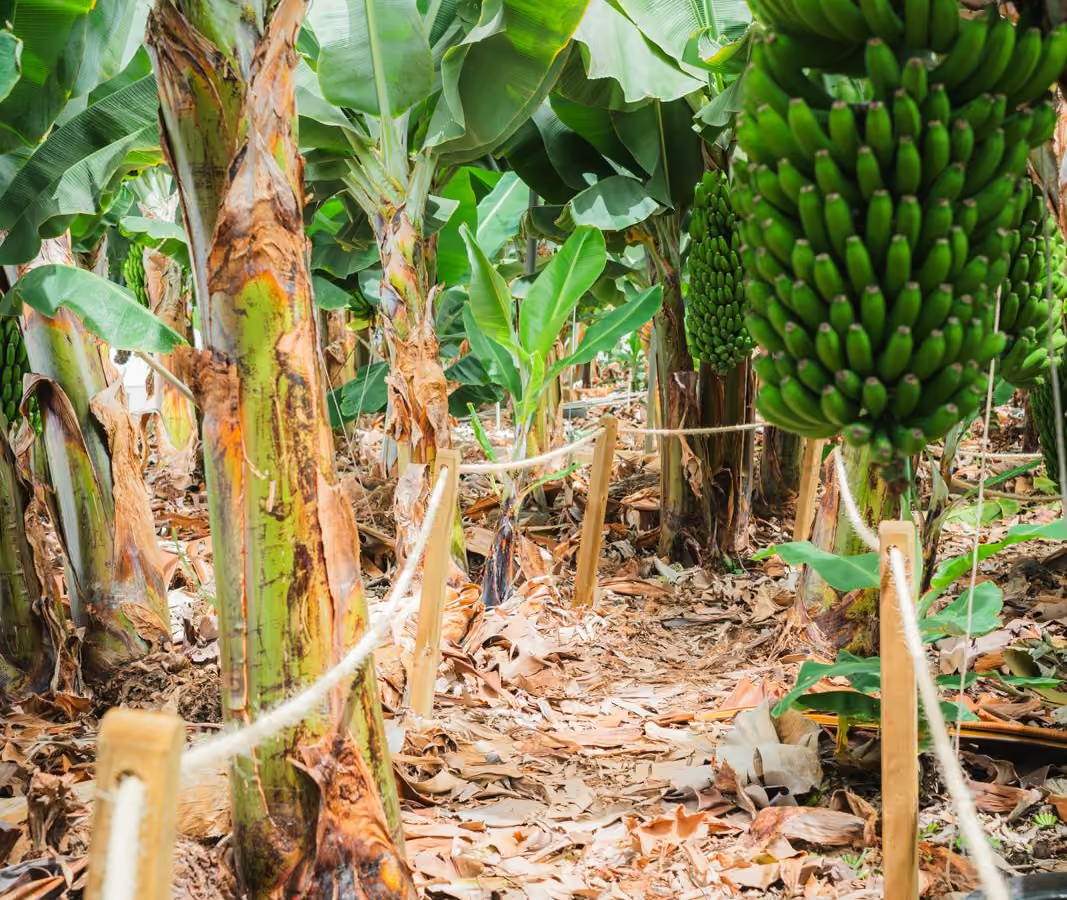
But this island has lived off bananas for more than a century. Those green patches you see from every road, running down from the midlands to the sea, are not scenery: they are the work that feeds half the island. And almost nobody who visits ever gets to understand how it works from the inside.
We are hardly impartial, so let us say it plainly: we have a farm in Tazacorte and we open it to visitors. The visit runs 2 h 30 min, you walk among the plants and it ends with a tasting of local produce at the table.
And if you would rather see it on another farm, that is fine: here are the three you can visit on the island, with what each one offers.
The natural areas, beaches, rock pools, stargazing and climate figures come from visitlapalma.es, the island’s official tourism website, checked on 12 October 2026. The timings, the advice and the opinions are ours, from living here.