
Visiting the Tajogaite volcano: what you can and cannot see
We live a few kilometres from the lava flows. This is not a tourist attraction, it is where many people here lost their homes. That said, you can visit, and it helps to know how.
by José Daniel Martín, Banana grower and co-founder of Finca Amor Platánico
Published on · Updated on
First, out of respect
The eruption began in September 2021 and lasted almost three months. It swallowed whole neighbourhoods, banana terraces, roads and the lives people had built over decades.
Here in the valley we all know somebody who lost everything. There are people who still have not been able to return home.
None of that stops you visiting, or makes it any less extraordinary to see. We only ask what we would ask anywhere something like this has happened: look, understand, and do not treat it as scenery.
What you can see on your own
There are public, free viewpoints from which you can see the cone and the lava flows. You drive, park and look. No permit and no guide required.
From Tazacorte, the Mirador de Las Hoyas is the one we recommend. It is on the LP-213 towards La Bombilla, has a proper parking area and, besides the valley and the banana terraces dropping to the sea, you see the new landscape the lava left behind. It is also the best sunset spot in the municipality.
Around the volcano itself, in the municipality of El Paso, there are other signposted viewpoints. And near the sea, the Punta Lava lighthouse, which stands on a solidified lava flow.
Always respect the signage. Some areas are restricted and the barriers are not there for decoration.
Going up to the cone is another matter
Getting close to the cone and the protected area cannot be done on your own. Access is regulated by the Cabildo of La Palma and you have to go with an authorised company.
This is not red tape for its own sake. There are volcanic tubes still at very high temperatures below the surface, ground that gives way, and gases. The companies that take people up have permission because they know where you can walk.
If you are interested, look them up and book ahead: the number of people allowed up each day is limited.
And wrap up far more than you would reckon from the coast. It is cold up there even if you are in shirtsleeves below.
Check the state of access before you go
This is the most important thing in the whole guide, and it is why I am not going to give you a list of what is open today: it changes.
The situation has evolved since 2021 and is still evolving. Some areas have reopened, others remain closed, and in some the concentration of gases determines what can be done, particularly in Puerto Naos and La Bombilla.
Before planning your day, check the access and incident status on the island’s official tourism site, or ask the Cabildo directly. If you go with a guided company, they will know the current position.
Any guide on the internet that tells you flatly what is open, this one included, may be out of date. Check.
What you will actually see
What impresses most is not the cone. It is the scale of the flows: kilometres of black rock running down to the sea, with the edge cut sharp where the lava stopped and, right beside it, green banana terraces untouched.
That contrast is the part you do not grasp until you see it. The lava came down where it came down, and ten metres away life carried on unchanged.
Then there is the fajana: the new land formed where the lava reached the ocean. Literally ground that did not exist before. It is clearest from the water, and there are short kayak routes from Puerto de Tazacorte that go close to it.
Fitting it into your day
The viewpoints are a short stop: a good half hour between arriving, looking and taking photographs. It is not a half-day plan unless you go up to the cone with a company.
It fits well late in the afternoon, on the way to the sunset, or alongside a morning in the valley. The full day is in the guide to things to do in Tazacorte.
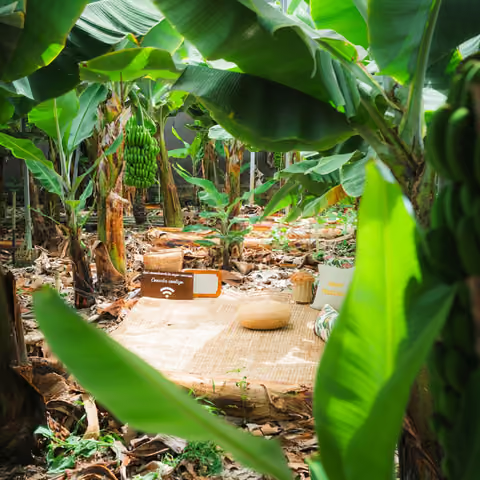
If you want to understand why this hit the area so hard, it helps to see first what the valley lives on: our farm visits are about exactly that.
If you are planning the whole trip, it is all in the guide to what to see and do in La Palma.
For the state of access and restrictions, the page to check is the notices and incidents page at visitlapalma.es, and the Cabildo of La Palma itself. Details of the Mirador de Las Hoyas come from turismotazacorte.es. Checked on 11 October 2026.